
Fabrication operations director
Economic buyer. Owns production rate, quality, rework, yield and safety. Judges us on FPY, rework hours and takt.
Weldeon is recruiting three to five design partners for paid pilots. This page describes who we are built for and how we work with them — not a customer list we have not yet earned.
Seven segments, one autonomy layer.
Named customers and traction are not yet public. We disclose partner status under NDA to prospective customers and investors rather than implying logos we do not have.
Welding and metal-fabrication manufacturers between roughly $150M and $40B in revenue, running cutting, forming, fit-up, welding and finishing lines: structural steel fabricators, shipyards, pressure-vessel and pipe-spool shops, wind-tower manufacturers, rail-car builders and heavy-equipment OEMs.
What they have in common is not size. It is that a single station decides the rate of the shop, a single missed indication can become a field escape, and there are not enough welders and fitters to solve either problem by hiring.
They also tend to have the ingredients autonomy needs: existing robotic welding or cutting, some inspection capability, and an MES or weld-data system that will talk to us.
Every deployment we have scoped involves the same three roles and the same two approvers.
Economic buyer. Owns production rate, quality, rework, yield and safety. Judges us on FPY, rework hours and takt.
Champion. Owns WPS, PQR, parameters and sequencing. Judges us on envelope discipline and deviation visibility.
Champion. Owns code conformance, NDT and genealogy. Judges us on whether the record survives an audit.
Approver. Owns network segmentation, integration and the security review.
Approver. Owns cell safety, interlocks and the change-management process for autonomous operation.
Approver. Owns the payback case and the expansion budget once the pilot converts.
Weldeon qualifies accounts where the economic buyer can tie one pilot cell to a measurable pain line.
The straightening and repair bays have quietly become a department with its own headcount plan.
A failed weld, a leak or a recall has made weld quality a board-level topic overnight.
Rate is capped by people who cannot be hired, and overtime has stopped working.
The inspection bay has become the constraint, and re-inspection hours are eating the schedule.
A client, a code regime or a notified body now wants weld genealogy the current system cannot produce.
Design partners get more of our attention and give us more of their reality. Both are priced into the arrangement.
We walk the line, look at the NDT records, and pick the cell where the pain has a number attached.
Targets, measurement method, baseline period and exit criteria are agreed in writing before integration begins.
Two weeks: controllers, sensors, MES, roles and a measured baseline of the current process.
Six to ten weeks of shadow mode then bounded write authority, with weekly reviews on the floor.
The scorecard is reviewed against the agreed targets. Design partners get published-case-study terms and preferential expansion pricing.
Volume
enough repeat weld value on one cell to show clear ROI
Access
robotic welding or cutting, NDT and MES with API access
Mandate
executive mandate to raise yield or cut rework and defects
Scorecard
willingness to run a paid pilot against a defined metric
“We would rather have five fabricators who will tell us the truth than fifty logos on a slide.”
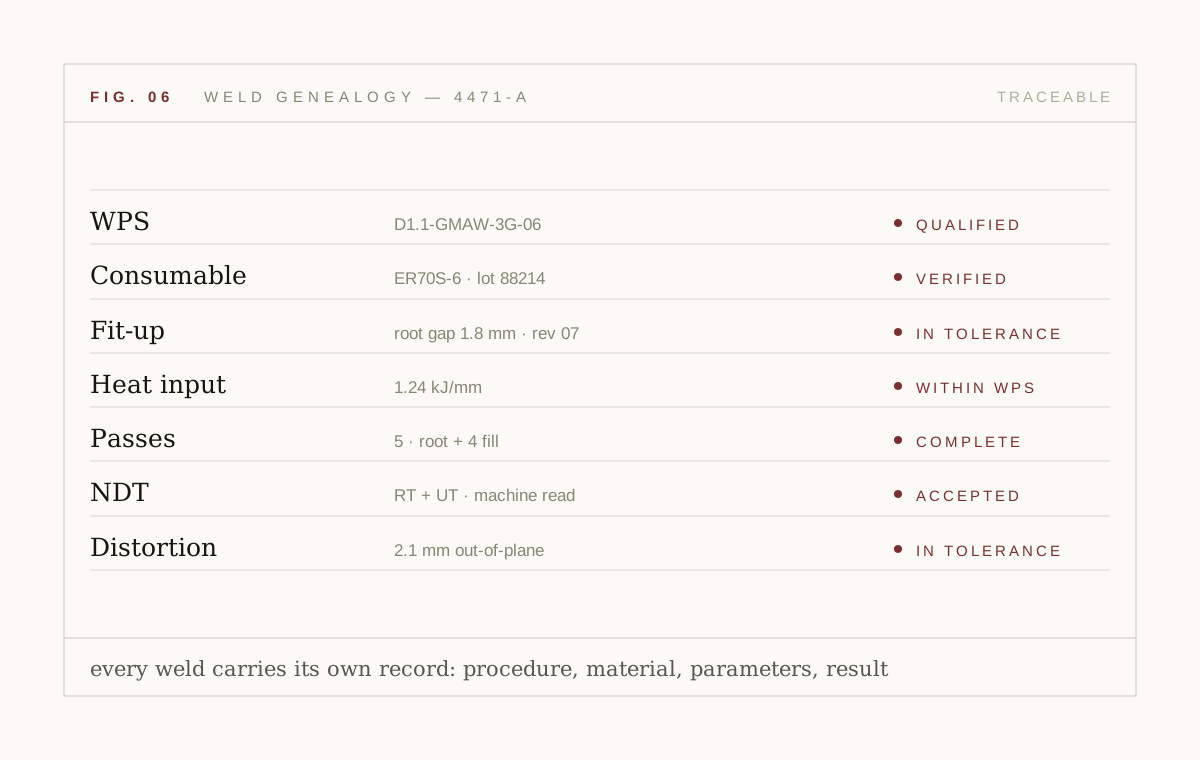
Design partners help shape the genealogy schema, the acceptance workflow and the code models — which means the standard that emerges is one they can live with.
Three pieces that explain how we think about the problem you are about to hand us.
Why the largest cause of lack of fusion happens before the arc strikes — and what measuring it changes.
The five lines every pilot scorecard needs, and the two that cause every argument.
What happens to takt when the constraint station cannot be staffed at all.
Not yet, and we will not pretend otherwise. We are recruiting design partners now. What we can share under NDA is our pilot methodology, the scorecard template and technical detail on the deployments in flight.
Preferential pricing, direct influence over the genealogy schema and code models, priority engineering attention, and published-case-study terms if the scorecard is met.
Yes — see our partners page. Many fabricators prefer their existing robotic integrator to lead cell-level work with Weldeon supplying the autonomy layer.
Book a pilot on one cell or line. We agree the scorecard before we start — first-pass yield, rework hours, defect escapes, takt — and we report against it in the open.