
Shop-floor escalation
For anything that has stopped a cell. Named contact on Factory and Enterprise; business hours on Cell.
Written for the four people who actually run a Weldeon deployment: the integrator, the welding engineer, the inspector and the operations director.
Nine books. The first three cover ninety per cent of a deployment.
Controllers, power sources, sensors and MES. Network topology, appliance placement and the two-week integration plan.
How a qualified WPS becomes an enforced envelope, who owns it, and how changes are reviewed and recorded.
How machine calls reach your inspector, how acceptance is recorded, and how adjudication feeds model improvement.
Part import, material behaviour, fixtures and restraint, and calibrating the twin against welds you have already measured.
Every field, its provenance, its retention and its export format.
Shift start, stop policy, escalation, and what to do when a cell drops to advisory.
Roles, authorities, sync policy, network segmentation and support-session handling.
Baseline design, metric definitions and the review protocol.
Version pinning, staged rollout across an edge fleet, and single-action rollback.
The CLI is how most shop-floor engineering teams check state, pull a weld record and confirm what the platform did.
$ weldeon site status --site bay-3
edge appliance    online   runtime 2026.03.1   uptime 41d
cells             6 connected   4 autonomous   2 advisory
loop latency      18 ms p50 · 27 ms p99
cloud sync        disabled (air-gapped)
pending export    0 records

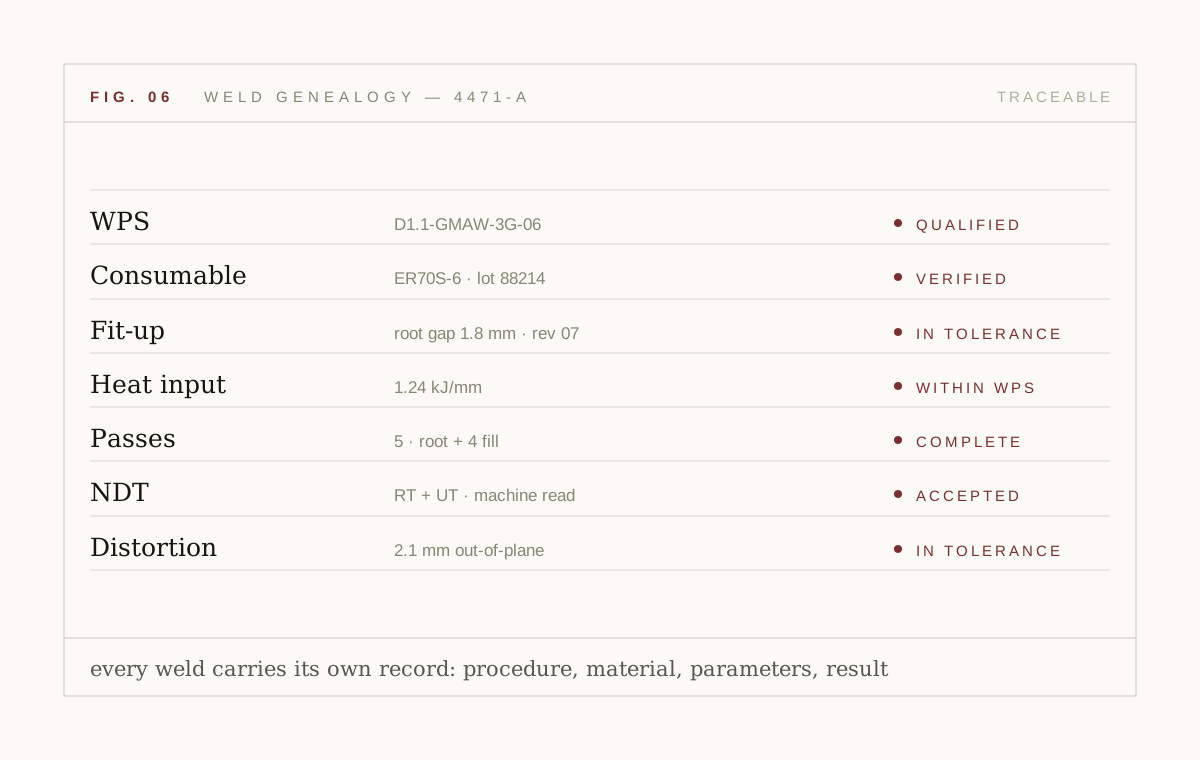
$ weldeon weld show 4471-A --format genealogy
wps               D1.1-GMAW-3G-06        qualified
consumable        ER70S-6 lot 88214      verified
fit-up            gap 1.8 mm rev 07      in tolerance
heat input        1.24 kJ/mm             within WPS
passes            5 (root + 4 fill)      complete
ndt               RT + UT machine read   accepted by J. Okafor
distortion        2.1 mm out-of-plane    in tolerance
Integration is not a formality. It is where a pilot is won or quietly lost, and it takes about two weeks when the preparation has been done.
Week one is physical and network: appliance placement, controller and power-source access, sensor mounting and calibration, and a read-only connection to the MES. Nothing is written to any machine during week one.
Week two is baseline and envelope: importing the qualified procedures, agreeing the confidence and stop policy, mapping roles to real people, and beginning the measured baseline period against which the scorecard will be judged.
The single most important configuration in the platform, and the one your welding engineer owns outright.
Machine calls never close themselves. This is the exact path from indication to disposition.
The canonical object in the platform. Everything else is derived from it.
What the operations team actually does with Weldeon running.
Check appliance and cell status, review overnight twin plans, confirm consumable lots against the plan.
Run the first assembly with heightened review; confirm fit-up measurements and pass parameters against expectation.
Monitor exceptions only. The platform surfaces deviations, low-confidence stops and indications; everything else is silent.
Advisory drops and stops route to the named engineer with the record attached. There is no anonymous alert queue.
Review deviations, indications and takt against plan. The report is generated from the genealogy, not typed.
Four channels, with the response you should expect from each.
For anything that has stopped a cell. Named contact on Factory and Enterprise; business hours on Cell.
Integration and API questions, handled by the engineers who wrote the adapters.
For code, envelope and audit questions — staffed by welding and quality engineers, not a helpdesk.
Every runtime and model release documented with behavioural changes called out explicitly.
9
documentation books covering deployment through audit
2 wks
typical integration duration for a single-cell pilot
1
canonical object — the weld genealogy record
100%
of parameter deviations recorded before the next pass
Partially. Architecture, API surface and the genealogy schema are shared with prospects under NDA; the full set ships with a pilot or subscription because it contains deployment-specific safety guidance.
Yes. Operator, welding-engineer and inspector training are part of every deployment, delivered on your floor with your parts.
With every runtime release. Behavioural changes are called out explicitly in release notes, because in this category a silent behaviour change is a safety issue.
Book a pilot on one cell or line. We agree the scorecard before we start — first-pass yield, rework hours, defect escapes, takt — and we report against it in the open.