
Robotic integrators
You design and commission cells. Weldeon adds the autonomy layer, and you keep the cell scope, the margin and the customer.
Weldeon is a product company, not an integrator. Cell design, mechanical work, fixturing and commissioning belong with the partners who already do them well.
Each has a different reason to work with us and a different commercial shape.
You design and commission cells. Weldeon adds the autonomy layer, and you keep the cell scope, the margin and the customer.
Power sources, robots, positioners, cutting and NDT systems. Deep adapter work and joint reference deployments.
Machine-read interpretation alongside your qualified inspectors, with adjudication data improving both sides.
Operations and quality consultancies using Weldeon as the instrument behind a transformation programme.
A welding cell is not a software deployment. It is fixtures, guarding, cable management, torch reach, positioner selection and a hundred mechanical judgements that take years to learn.
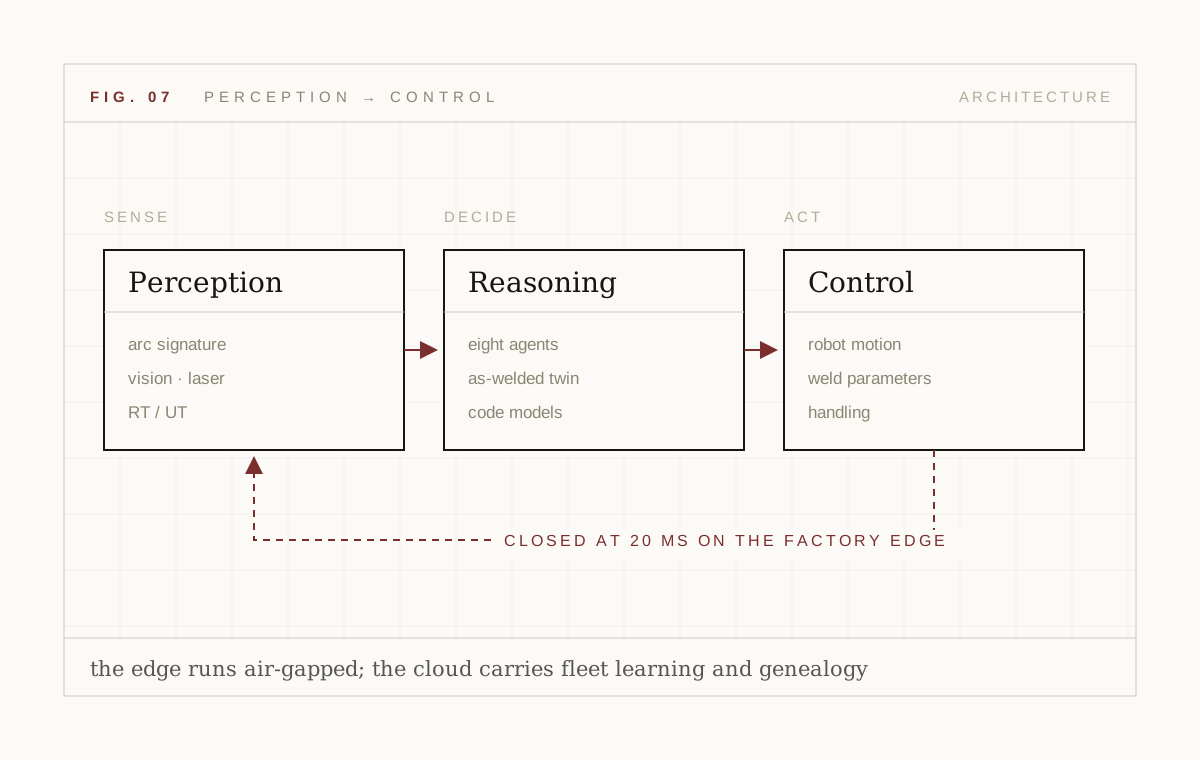
Weldeon has no ambition to build that competence. Our value sits in perception, reasoning and bounded control — the layer that makes an existing cell adaptive rather than programmed.
So the partnership is unusually clean. Integrators keep cell scope and margin; OEMs sell more capable equipment; NDT providers extend their throughput; and fabricators get one team accountable for the metal and one for the intelligence.
Four stages, with commercial terms defined at each.
Adapter coverage for your controllers and equipment is confirmed or scoped. Gaps are quoted honestly.
One shared customer deployment with clear scope boundaries and a shared scorecard.
Your engineers are trained on integration, envelopes and the operations runbook, with materials you can reuse.
Referral, resale or co-sell terms depending on how you prefer to hold the customer relationship.
Adapter coverage is the practical starting point for most partner conversations.
The autonomy layer reads sensors and writes bounded parameters and motion. Everything mechanical, electrical and safety-related in the cell stays with the integrator.
Scope
cell integration scope and margin stay with the integrator
Reuse
adapter work done once is reused across your customer base
Evidence
shared scorecards you can take to your next prospect
Support
direct access to the engineers who wrote the adapters
“Integrators build the cell. We make it adaptive. Confusing those two roles helps nobody.”
Short list, held firmly.
No implied certifications, no customer results that have not been published, no autonomy claims beyond the envelope.
Nobody configures a route around a qualified range — not in commissioning, not under schedule pressure.
Deployments are led by engineers who have completed enablement. This is a safety-critical process.
Adapter edge cases and failed deployments come back to us fast. That is most of the value we get from partnering.
Tell us what you build or install, and which customers you serve. We will come back with adapter coverage and a proposed first step.
Yes, and we say so plainly. Where a fabricator already has an integrator relationship, we prefer to work through it — the deployment goes better and the customer is better served.
Whoever holds the relationship, defined per deal before it starts. Referral, resale and co-sell terms all exist precisely so this is never ambiguous.
Under a resale agreement with trained engineers, yes. We do not allow resale into deployments led by engineers who have not completed enablement.
Book a pilot on one cell or line. We agree the scorecard before we start — first-pass yield, rework hours, defect escapes, takt — and we report against it in the open.