
Perception, reasoningand control —on the shop floor.
Weldeon is one platform with three layers: it senses the joint, reasons about the weld on a physics-aware twin, and acts on the robot and the parameters inside the envelope your welding engineer qualified.
A closed loop with a 20-millisecond waist
Perception, reasoning and control run on a factory edge appliance so the loop closes at welding speed. The cloud carries what can wait: fleet learning, benchmarks and long-horizon genealogy.
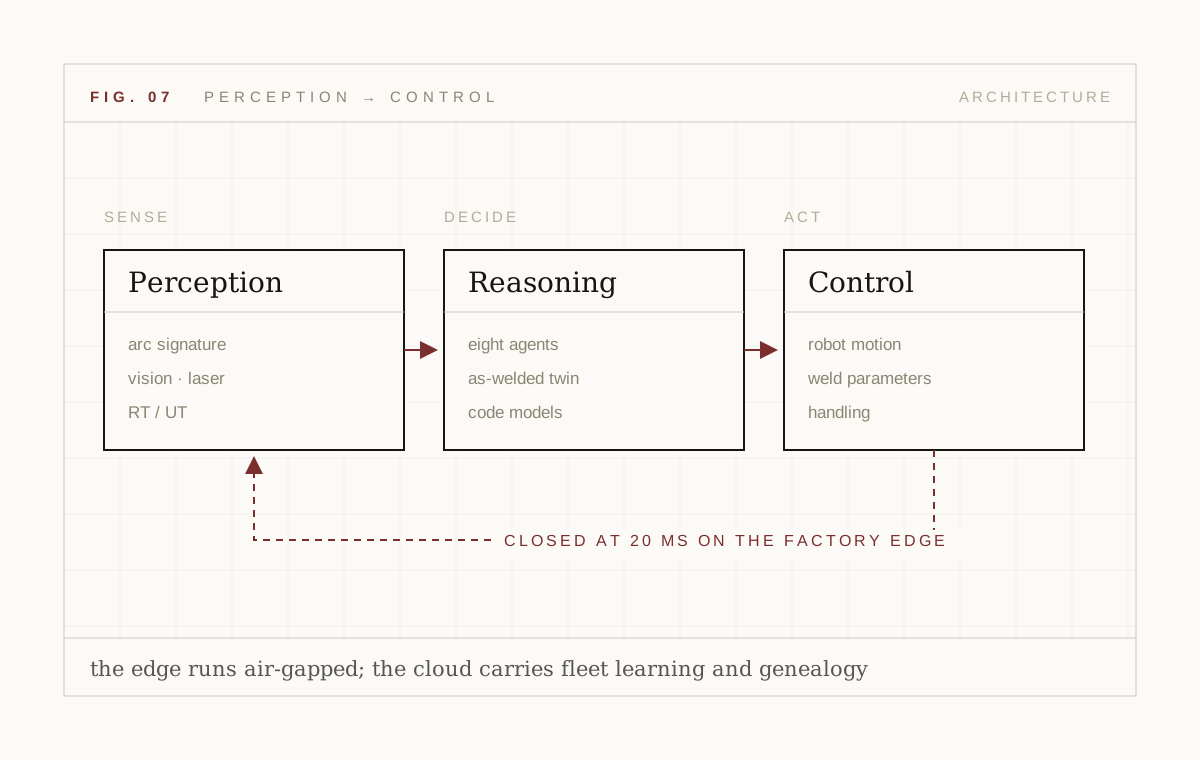
Perception: reading a joint that will not hold still
Welding is a sensing problem before it is a control problem. Plate arrives with mill tolerance, cutting adds its own, forming springs back, fixtures relax, and heat moves everything again during the weld itself. The joint you programmed is never quite the joint in front of the torch.
Weldeon fuses laser seam tracking, through-arc sensing, structured light, thermal imaging and shop vision into one live estimate of the joint: gap, alignment, bevel angle, root face and the position of the weld pool. Radiographic and ultrasonic data join the same record after the fact, so the platform learns which arc signatures preceded which indications.
The output is not a video feed for a human to watch. It is a metric estimate with an uncertainty attached — the input a controller can actually use.
Reasoning: the as-welded digital twin
The twin is a physics-aware model of the part as it will be welded, not as it was drawn. It carries the joint geometry, the material and its thermal behaviour, the fixture, the weld sequence, and the heat that each pass will deposit.
Run it before the shift and you get the questions that matter answered in software: which sequence keeps distortion inside tolerance, where residual stress will concentrate, which station will breach takt, and which joint is most likely to produce an indication.
Run it during the shift and it becomes a reference. When measured behaviour drifts from predicted behaviour, something real has changed — a consumable lot, a fixture, a plate supplier — and the platform says so.
Control: authority with a hard boundary
Weldeon writes to the robot and the power source, but never outside the envelope your welding engineer qualified. The WPS is a constraint on the controller, enforced in code and logged on every write.
Within that boundary the platform is genuinely autonomous: it adjusts travel speed and wire feed for a widening gap, re-plans the approach around a positioner, adds or removes a pass, re-sequences to balance heat, and stops the cell when confidence falls below the threshold you set.
Every action is attributable. Every deviation is recorded. Autonomy that a quality engineer cannot audit is not autonomy a fabricator can ship.
What the platform is made of
Eight agents, deployed together or one at a time. Each is bought, priced and proven on its own.
- 01
Cut & form
Controls plasma, laser and oxy cutting, nesting, bending and forming so plate and sections leave the front of the shop at the geometry the joint actually needs.
- 02
Fit-up & tack
Senses and controls root gap, alignment, bevel and tack placement — the single largest upstream cause of weld failure and rework.
- 03
Weld & parameter
Runs robotic arc, laser and resistance welding: heat input, travel speed, wire feed, weave and real-time seam tracking, pass by pass.
- 04
Distortion & stress
Plans weld sequence, balances heat, and predicts out-of-plane distortion and residual stress before the assembly leaves tolerance.
- 05
Defect & inspect
Reads X-ray, ultrasonic and vision data to detect and predict porosity, cracks, lack of fusion, undercut and slag — machine-read, engineer-approved.
- 06
Yield & takt
Optimises first-pass yield, rework hours and line balance across cutting, fitting, welding and finishing stations.
- 07
Robot & handling
Drives welding robots, positioners, gantries and part handling — including approach, reach and collision-free motion around large weldments.
- 08
Quality & conformance
Holds right-first-time, non-conformance, weld genealogy and code traceability to AWS D1.1, ASME BPVC, ISO 3834 and EN 1090.
“Autonomy that a quality engineer cannot audit is not autonomy a fabricator can ship.”
Three ways to run it
Most fabricators start with one cell and an edge appliance. The topology grows with the scope.
One welding or cutting cell, one edge appliance, one workflow proven end to end.
- Hardware
- One factory edge appliance, GPU-accelerated, rack or cabinet mounted.
- Network
- Local to the cell controller; no inbound internet required.
- Scope
- Weld and parameter control, or cutting, or inspection.
- Time to value
- Two weeks to first controlled pass; scorecard at eight to twelve weeks.
The full loop across cutting, forming, fit-up, welding, distortion, NDT and finishing.
- Hardware
- Edge fleet, one appliance per line or bay, centrally managed.
- Network
- Shop-floor VLAN with an optional one-way sync to your tenancy.
- Scope
- All eight agents plus the as-welded twin.
- Time to value
- Rolling deployment, line by line, over one to two quarters.
A fabrication or OEM group standardising on one autonomy layer.
- Hardware
- Edge fleet across sites with staged rollout and version pinning.
- Network
- Per-site isolation; cross-site learning is opt-in per data class.
- Scope
- Custom material, joint and code models; group-level benchmarks.
- Time to value
- Reference site first, then a repeatable site playbook.
The equipment it already speaks to
Integration is the first two weeks of a pilot, not the first two quarters.
- Welding power sources
- Fronius, Lincoln Electric, Miller, ESAB, EWM and Kemppi digital interfaces for parameter read and bounded write.
- Robots & positioners
- FANUC, ABB, KUKA, Yaskawa Motoman, Panasonic and Cloos controllers, plus headstock, tailstock and gantry positioners.
- Cutting & forming
- Plasma, laser and oxy tables, press brakes and roll formers via OPC UA or vendor APIs.
- Inspection & NDT
- Digital radiography, phased-array ultrasonic, laser profilometry and shop vision — DICONDE and vendor formats.
- Seam & joint sensing
- Laser seam trackers, through-arc sensing, structured-light scanners and thermal cameras.
- MES, ERP & quality
- SAP, Oracle, Plex, Tulip, Fabsuite, Tekla, and weld-data systems for WPS, PQR, welder qualification and traceability.
Where the platform runs
20 ms
control loop at the factory edge, sensor to actuator
8
agents, deployable together or one at a time
4
code regimes modelled: AWS D1.1, ASME BPVC, ISO 3834, EN 1090
0
bytes required to leave the site for the loop to close
Latency and envelope figures describe the platform's design targets on reference hardware. Site performance is validated during pilot integration.
Every weld leaves a record
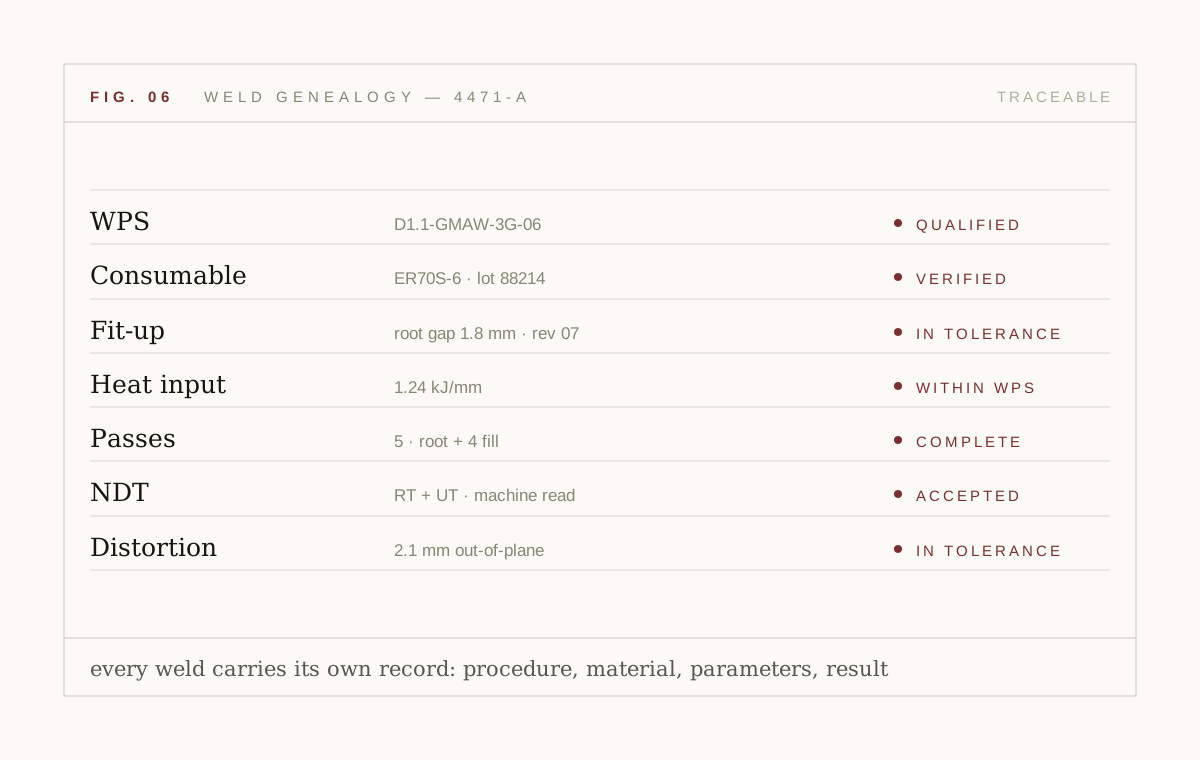
Weld genealogy is not a reporting feature bolted on at the end. It is a by-product of the control loop — the platform can only act on what it has already recorded.
Platform questions
-
Yes. The control loop, the twin and the inspection models run entirely on the factory edge appliance. Cloud sync is opt-in and can be disabled per site or per data class.
-
No. Weldeon layers on the equipment you own. We read and write through existing controller and power-source interfaces; where a controller is too old to expose a safe write path, we start in advisory mode.
-
It stops or degrades to advisory, according to the policy you set per cell. A low-confidence weld is escalated to a human, not guessed at.
-
During integration we baseline against welds you have already made and measured. The twin is fitted to your materials, fixtures and joints before it is trusted to plan sequence.
Bring autonomy to thearc, the fit-up andthe inspection bay.
Book a pilot on one cell or line. We agree the scorecard before we start — first-pass yield, rework hours, defect escapes, takt — and we report against it in the open.